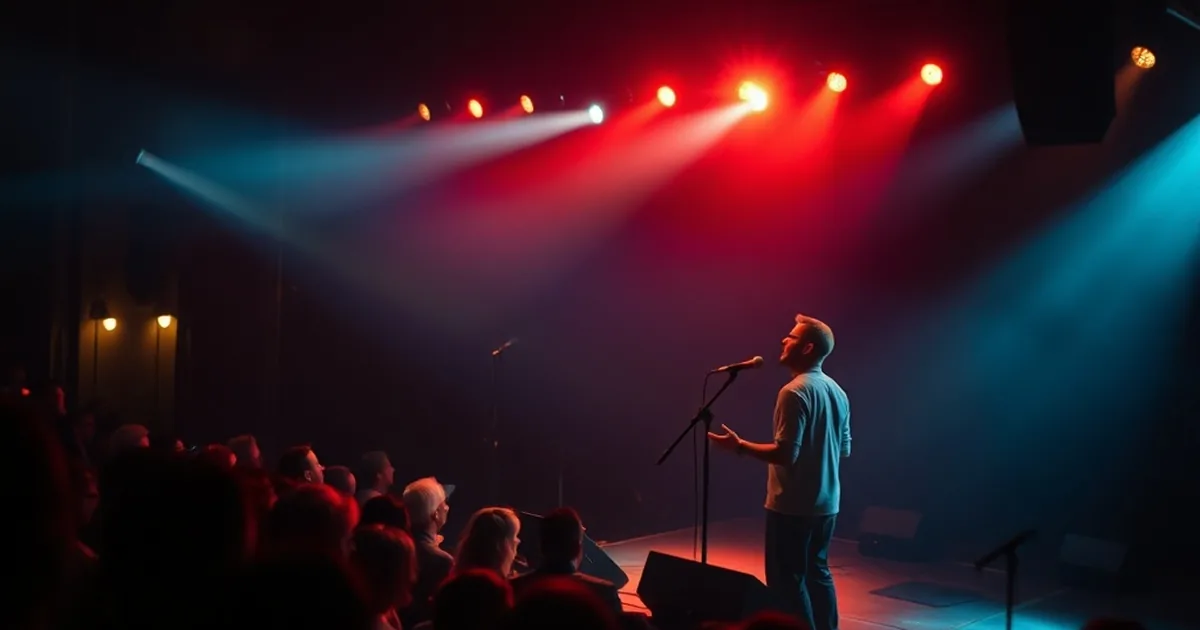
Magnus Uggla concerts summer 2026: the evening at Dalhalla
The chorus of "Kung för en dag" is right there, ready to be pulled out at any summer party, and "Jag mår illa" is something you've sung along to without really thinking about it. The man behind them is one of the summer's biggest draws, and among all Magnus Uggla concerts there is currently one confirmed show in our calendar. But here's the detail few people know: the artist who today fills stands sold almost nothing at all in the beginning. His first two glam- and art-rock-inspired albums, Om Bobbo Viking and Livets teater, sold poorly, the first only around 500 copies in Sweden.
That he kept going anyway says something about the man. And just to add another one to the shelf: his family tree, according to the record label's own biography, is anything but ordinary. Magnus Uggla was born as Per Allan Magnus Claesson Uggla in Stockholm on 18 June 1954, and as a member of the Swedish nobility he counts among his ancestors several European rulers, including Johan III, Gustav Vasa and even Charlemagne. One of his most beloved songs also finished last in Melodifestivalen before becoming a hit, but more on that further down.
Magnus Uggla concerts 2026: what you need to know
Right now there is one confirmed Uggla show in the calendar: Dalhalla in Rättvik on 11 July 2026, an outdoor concert in an old limestone quarry. If you want to see him live this summer, that is the date to keep track of.
Anyone searching for Magnus Uggla concerts will find the event Magnus Uggla 2026 at Dalhalla on our site. At the time of writing it is the only confirmed show in our calendar, so honestly you need to act quickly, because Dalhalla evenings with Swedish crowd favourites tend to fill up. The venue is no ordinary concert arena but a blasted pit in the rock, which we will come back to. More about the artist himself can be found on his artist page with us, and if you want to compare with what else is happening this summer you can browse our concerts.
One more thing that speaks in favour of this particular evening: Uggla is still very much active. The latest single in his repertoire is called "Bästa kebaben i hela stan". This is no museum evening, then, but an artist who is still writing new material.
From 500 records sold to beloved satirist
Uggla started in hard rock and took a long detour before becoming the satirist people associate him with today. The turning point came after a concert at Gröna Lund.
It started early. Uggla started his first band in 1968 with neighbours in Nacka, JUSO, an abbreviation of the members' surnames, and the band played hard rock with influences including Black Sabbath. He was the vocalist in the hard rock band JUSO, later renamed Alexander Lucas, with influences such as Black Sabbath, The Groundhogs and Alice Cooper, before going solo in the early 1970s. His solo records sold almost nothing, as mentioned. Then something happened. After seeing The Clash at Gröna Lund he went home and wrote a new record that would become his big breakthrough.
The result was a completely different kind of sales. The departure from glam rock with the punk- and hard-rock-inspired Va ska man ta livet av sig för när man ändå inte får höra snacket efteråt gave him great popularity, and the album sold around 150,000 copies. During this period he was given a nickname by the music press. In the 1970s several music magazines gave him the name "The Swedish Ian Hunter". His influences were a colourful bunch. Among his solo influences were Karl Gerhard, David Bowie, The Clash, Marc Bolan, Wendy Carlos and Mott the Hoople.
It was not until the 1980s that satire became his signature. With the album Välkommen till folkhemmet in 1983, Uggla brought satire into his lyrics, which would become his hallmark. Broad recognition still came slowly. Uggla's albums early on created a kind of cult following and stayed just below the general public's radar until 1991. Then came the award that turned things around, and it came from close quarters. In 1991 Uggla was awarded the Karamelodiktstipendiet by his mother's cousin's husband Povel Ramel and later appeared in his revue Knäpp igen.
A lesser-known side of him colours both his lyrics and his stage persona. In the SVT programme "Min sanning", Magnus speaks openly about his childhood and longing for time with his mother, that both parents were busy careerists and that he was quite unhappy as a child. Their lack of presence meant he developed a close relationship with the family's housekeeper Poppe, whom he calls his surrogate mother and who meant a great deal to him.
That he is still going strong after half a century is reflected in his list of awards. In the 1980s and 90s he became the great king of the Rockbjörnen and can boast seven statuettes of the prize voted for by Aftonbladet's readers. In 2017 he received the honorary prize at the Grammisgalan, and in 2021 he was awarded the royal medal Litteris et Artibus, presented by the royal couple. In total he has released around twenty albums, including live albums.
The songs you will hear on stage
An Uggla concert is a cross-section of several decades of Swedish pop, from punky 1970s satire to the sing-along classics that have become public property. Here are the stories behind some of them.
Take "Johnny the Rocker", which was promised in the introduction. Two years after his breakthrough, Uggla participated in Melodifestivalen for the first time and came last with "Johnny the Rocker", while the victory instead went to Ted Gärdestad with "Satellit". Last on paper, but the public judged differently, because the song became one of the most played in his repertoire. That says something about the distance between a jury and what audiences actually sing along to.
The repertoire spans widely. Among the Swedish classics are Kung för en dag, Trubaduren, Dansar aldrig nykter, Astrologen, Ska vi gå hem till dig, Johnny the Rocker, Jag mår illa and Varning på stan. Uggla himself has clear favourites among them. About "Trubaduren" he says it is the best lyric he has ever written, and about "Kung för en dag" that it fulfils every criterion of a good hit song. Another record is one he returns to often. Alla får påsar, which he made in 1993 together with Anders Glenmark, he calls his best album, with some of the songs he still plays today.
Glenmark is no coincidence. Uggla emphasises that a good producer should be able to lift a song, and mentions that "Fyra sekunder" was fairly mediocre to begin with but became something much bigger with Glenmark's arrangement. And Melodifestivalen lured him back much later. He participated in Melodifestivalen 2007 with the entry "För kung och fosterland", which advanced to the second chance round but missed the final. One of his most talked-about performances came off stage. In the TV4 programme "Så mycket bättre" in 2012 he sang Olle Ljungström's "Jag och min far", one of the programme's most memorable interpretations.
Dalhalla: concert at the bottom of a tropical sea
Dalhalla is a disused limestone quarry outside Rättvik that has been transformed into one of Europe's most talked-about outdoor stages. And no, "bottom of a tropical sea" is not a metaphor.
The story behind it is worth knowing. Seven kilometres outside Rättvik lies the old limestone quarry Draggängarna, where limestone extraction began in 1949 and ended in 1990. That it became a stage was one person's achievement. Margareta Dellefors, with experience as an opera singer and head of production at Sveriges Radio, was looking for an outdoor stage for opera and drama, and Dalhalla became the place. She auditioned an aria at the bottom of the vast pit and realised the acoustics were perfect. Margareta Dellefors, who inaugurated the arena in 1994 and was its artistic director until 2003, passed away in 2024 at the age of 98.
The dimensions explain part of the sound. The limestone quarry is 60 metres deep, 400 metres long and 175 metres wide, which provides excellent conditions for high-quality acoustics. The arena has a natural sound reproduction with an echo of up to two seconds, something that has made the venue famous among sound engineers worldwide. The name is a play on words. The name is a reworking of Norse mythology's Valhalla, inspired by Richard Wagner's operas and adapted to "Dalhalla" because of its geographical location in Dalarna.
And then there is the matter of the sea. When you sit and enjoy the music you are sitting at the bottom of an ancient tropical sea, where metre-long primeval squid once swam and can now be seen as fossils in the rock wall. The weather can also become part of the show. During heavy rain a small waterfall forms along the cliff wall behind the stage, which is sometimes used as part of the stage show. The company on the artist list over the years speaks for itself. Among more pop-oriented names, Dalhalla has hosted Norah Jones, Sting, Patti Smith, Kraftwerk and Neil Young. The Austrian music festival magazine Magazin Festspiele ranks Dalhalla as the fourth best outdoor arena in the world for music events.
Practical tips for the evening in the limestone quarry
A little preparation will save you from the most common mistakes at Dalhalla: wrong clothes, wrong shoes and transport stress. Here is the most important information to know before you go.
Start with clothing, because that is where people most often get it wrong. The evenings can get considerably colder than many expect, even in the middle of summer, and many people stand in a t-shirt during the day but later wish they had brought a warm jumper or thin jacket. Bring a blanket, or buy one on site. Many recommend bringing a blanket, as it gets cold down there once the sun disappears. The concert goes ahead regardless of the weather. Dalhalla is an outdoor arena and events are not cancelled due to rain or wind, so dress according to the weather. A rain poncho usually works better than an umbrella at concerts.
Your seat is worth thinking about. Section C is often considered the best as it sits directly opposite the stage, and sections B and D are also highly regarded. And good shoes, because it is not flat ground. There are many steps in the auditorium; from the car park and entrance it is possible to walk down the slope to the concert area without steps all the way to row 36, but the final slope is steeply inclined.
A few rules are good to know in advance. A total bag ban applies at all Dalhalla events until further notice, and it is not permitted to bring your own food or drink. The entrance opens 2.5 hours before the concert starts, and Dalhalla is cashless and accepts card payment only. Getting there requires a little planning. Pre-book a shuttle or taxi, as last-minute options are often fully booked, and tickets for shuttle buses are sold separately and easily sell out before the concert. On the site itself there is also an internal bus. The arena bus runs between the car park and the concert area; a single journey costs 40 kronor and is paid on site by card, it cannot be pre-booked.
Tickets for the concert itself are purchased through the official channels, i.e. Dalhalla's own ticket sales. Our event page for the concert on 11 July links through to the ticket sales, so you will end up in the right place.
More Uggla evenings this summer
If you miss Dalhalla there are more evenings with an Uggla connection in the calendar: a tribute show in Malmö and an entirely separate artist with the same surname.
In Malmö, 100% Uggla is performed on 3 July 2026 at Café 1851, a tribute format built around Magnus Uggla's songbook for those who want the sing-along without travelling to Dalarna. And there is another Uggla on the stages this summer. Caroline af Ugglas plays in Trosa on 4 July, among other dates, an evening you can find via our page for the concert at Garvaregården. If you want to see what else is happening during these summer weeks, our events calendar is the right place to start.
Frequently asked questions about Magnus Uggla concerts
When and where does Magnus Uggla play this summer?
The confirmed show in our calendar is at Dalhalla in Rättvik on 11 July 2026. You will find the date and ticket link on the page for Magnus Uggla 2026. At the time of writing it is the only confirmed date with us, so keep an eye out if you want to be sure of a place.
Where do I buy tickets?
Always go through the official channels, i.e. Dalhalla's own ticket sales. Our event page links through to them, and bear in mind that shuttle buses and transfers are booked separately and often sell out before the concert.
What songs does he usually play?
Expect a cross-section of his career. Classics such as Kung för en dag, Trubaduren, Dansar aldrig nykter, Astrologen, Ska vi gå hem till dig, Johnny the Rocker, Jag mår illa and Varning på stan are among the best known. The fact that he is still releasing new singles means that some newer songs may also appear in the setlist.
What is it like to see a concert at Dalhalla?
It is an outdoor stage in an old limestone quarry with tiered seating down towards the stage. The seats are built in stone with wooden seats, so many people bring a seat cushion for extra comfort. Dress warmly, as the evenings can turn cool even in summer, and bring a rain poncho if the weather looks uncertain.
Are there more Uggla evenings if I miss Dalhalla?
Yes. In Malmö the tribute show 100% Uggla is on 3 July, and the artist Caroline af Ugglas plays in Trosa on 4 July, among other dates. Both are in our calendar with ticket links.
Sources
- Magnus Uggla 2026, Dalhalla, Rättvik, 11 July 2026 (nupagang.se)
- 100% Uggla, Café 1851, Malmö, 3 July 2026 (nupagang.se)
- Caroline af Ugglas, Garvaregården Trosa, 4 July 2026 (nupagang.se)
- Artist page: Magnus Uggla (nupagang.se)
- Wikipedia: Magnus Uggla (English-language edition, en.wikipedia.org)
- Apple Music and Spotify, artist biography for Magnus Uggla
- Stim.se, interview with Magnus Uggla; Nöjeslivet.se
- Riksdag open data on Dalhalla; Visit Dalarna and dalarna.nu
- SVT Nyheter Dalarna, on Margareta Dellefors; Opulens.se
- Official practical information from dalhalla.se and travel operators