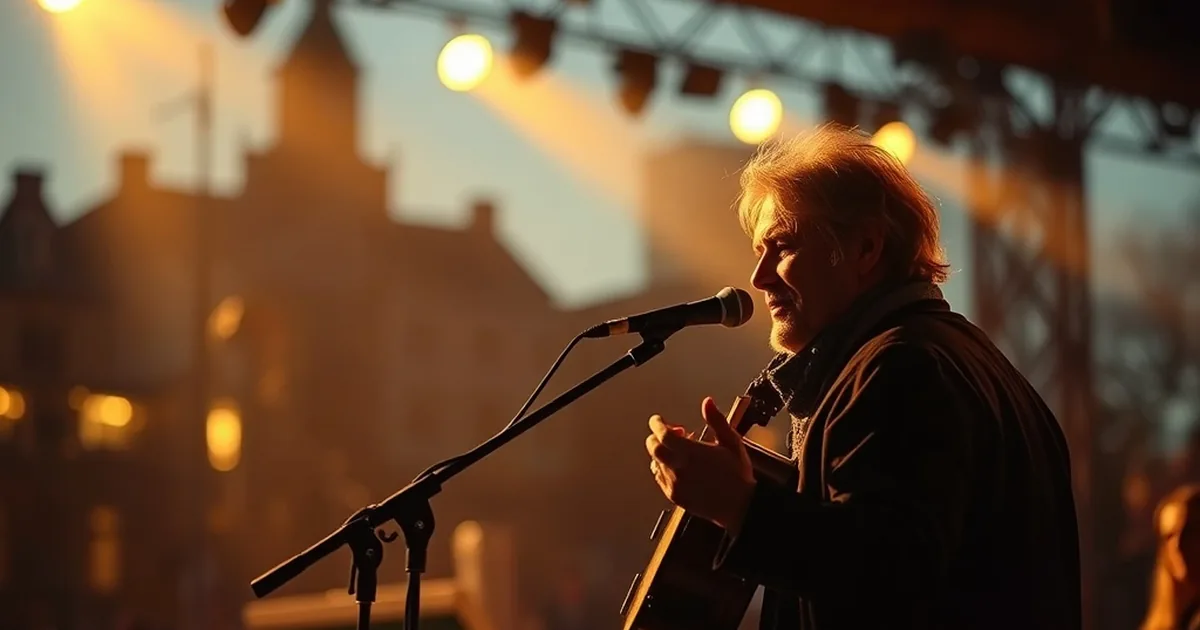
Stefan Sundström concerts 2026: what the summer tour looks like
You probably recognise the voice even if the name means nothing to you. That rough, talk-singing tone telling stories about Jan Banan and the ever-returning Sabina, somewhere between Cornelis Vreeswijk and a punk who has passed forty. Here is the detail most people miss: the man behind the songs grows his own snus, produces his own food and was named Årets hållbara artist at the Grammisgalan in 2021. He is out again now, and anyone who wants to see Stefan Sundström concerts in 2026 has several chances this very summer. Next up, he plays Debaser in Stockholm on 13 July.
That he would become one of the country's most long-lived visa troubadours was never a given. He was perhaps too raw and unsophisticated to ever reach a really large audience, and no, he could not sing, but he still became the most influential Swedish songwriter of the 1990s, together with Lars Demian. That unpolished authenticity is still the whole point of a Sundström evening.
Stefan Sundström concerts summer 2026
Summer 2026 brings four confirmed Stefan Sundström concerts in our calendar, starting in Stockholm in mid-July and continuing in Mälardalen and Värmland. Tickets are sold through the organisers' own channels.
First up is home turf. On 13 July he plays Debaser in Stockholm, an evening marketed under the name "Sommar på Pontonen". In our calendar this evening appears in two places: both as 13/7 Stefan Sundström, Debaser Pontonen and as Stefan Sundström - Sommar på Pontonen with the venue listed as Debaser Strand. It is the same Debaser by Hornstull's waterfront in Stockholm and the same date, so do not be confused. Check both pages for ticket links before you book.
After that it rolls on. He plays The Nut House in Upplands Väsby on 23 July, Trossen in Kristinehamn on 24 July and closes the weekend with Sommar på Vinön at Vinöns Värdshus in Odensbacken on 25 July. Four shows in just over a week, spread between a major city, a suburb, Värmland and a small island in Hjälmaren. The complete list is further down in the text.
Who is Stefan Sundström?
The short version: a Stockholm kid who went from small bands in the south of the city to becoming one of the heirs to the Swedish visa tradition, and who still writes social commentary with a twinkle in his eye.
Sundström grew up in Stockholm, learned to play guitar at fifteen and released two singles in 1980 with the group Trots. Then it took time before things took off. He broke through in the late 1980s with the band Apache and has been recognised several times for his work in upholding the Swedish visa tradition. A small personal detail that says something about how he works: he is married to Karin Renberg, who also plays guitar in his band.
Today he is far more than just a musician. Alongside the songs he is an author, columnist and a frequent voice in climate debates, and he has published several books. One of them, Låtar, funderingar och bilder, collects texts from his entire 30-year career and portrays the decades that shaped him as an artist and a person.
From cassette tapes to Nästan som reklam
Sundström's path began small, literally on cheap cassettes, and reached its commercial peak with a record that sounded completely different from anything he had done before.
The idea was democratic. He envisioned a market of cheap cassettes to make the music accessible to everyone, and spent eight years releasing tapes on non-profit labels such as Sista Bussen. The breakthrough album is usually placed at the end of the 1980s. Renjägarens Visor from 1989, regarded as his first proper album, was in fact also released on cassette and within a few years became almost impossible to find, with the band Apache as backing group.
Then the records came one after another. After signing to MNW he released Happy Hour Viser, Hå Hå Ja Ja and Vitabergspredikan, all with Apache. His by far best-known song came a little later, and it was born out of a deliberate change of style. For the next album he chose a completely different backing of violins, cellos and choir, and the title track "Nästan som reklam" became his biggest hit. The fact that it sounded so unlike his earlier, rockier songs is precisely what makes it so typical of him: he refuses to repeat himself.
Here we also clear up a common mix-up. Apache was his backing band, not Weeping Willows. It was not until 1995 that the musicians from Apache, together with singer Magnus Carlson, formed the cover band Weeping Willows, which soon set out on its own and commercially far more successful path. Sundström thus stayed with the songs while his old backing musicians took the radio-hit route. After a reunion with Apache came Babyland in 1997.
The awards have stacked up over the years. He has received the Cornelispriset, Gröna Lunds Evert Taube-pris, Stockholms stads Bellmanspris and the Fred Åkerström-stipendiet, to name a few. The legacy is clearly visible in those who have learned from him. The style has roots in an old Swedish visa tradition going back to Evert Taube and the 18th-century poet Carl Michael Bellman, but also contains straight rock and roll, and it was copied by countless hopeful bands and became a kind of informal benchmark against which younger songwriters, such as Lars Winnerbäck, were measured.
Jan Banan, Sabina and the others
If you listen to Sundström you soon meet the same people again and again. They are not real people but recurring figures he has invented in order to tell stories more freely.
Jan Banan, Marguerite, Jonny Dunder and Sabina are imaginary friends that Sundström has used to make reality less recognisable in his songs. Sabina is the one who has stayed longest. She is a mythical female figure who has followed him for many years, the essence of women he has met but also of some who have never existed in his life. The decision to make her fictional was deliberate: he did not want people to get hung up on who Sabina was in real life, but for her to become a figure in the listener's own mind.
The names appear in titles such as "Har någon sett Sabina?" and "Sopvisa för Jan Banan", and they tie the albums together into one ongoing story about a Sweden in change. It is that kind of everyday realism, with equal parts humour and seriousness, that makes a Sundström evening feel more like listening to a story than watching a show.
The grower, the fisherman and Årets hållbara artist
Away from the music, Stefan Sundström is a committed self-provider, and that shapes both the lyrics and the person on stage.
His interests are not the usual rock-star attributes. His great interests besides music and writing are growing, subsistence fishing and producing food. And snus. He practises what he preaches. He lives essentially self-sufficiently, and the commitment has ultimately been rewarded beyond the purely musical. At the Grammisgalan 2021 he received Årets hållbara artist, an award established in 2017 by Grammis and Oatly to recognise artists who highlight climate and environmental issues.
The jury's wording captures the breadth of his commitment. Had the award had different sub-categories, Sundström would probably have swept them all, they wrote, given everything from sustainable home-growing and the state of the oceans to anti-flying initiatives and sustainable touring. That is the man who meets the audience on stage too, and he does it without a grand apparatus. The live performances are marked by presence, honesty and direct contact with the audience.
How to buy tickets and what to expect
Tickets are sold through the organisers, not through us, and several of the shows take place at small venues with a limited number of places. Here are the four summer dates gathered together:
- 13 July - Debaser, Stockholm ("Sommar på Pontonen"). Tickets via Debaser and Tickster, linked from the two event pages above.
- 23 July - The Nut House, Upplands Väsby. Tickets via Tickster.
- 24 July - Trossen, Kristinehamn. Tickets via Tickster.
- 25 July - Vinöns Värdshus, Odensbacken ("Sommar på Vinön"). Tickets via Tickster.
In practice that means the Stockholm evening is purchased through Debaser's and Tickster's pages, while Väsby, Kristinehamn and Vinön go via Tickster. Since several of the venues are intimate outdoor terraces and inns it can sell out early, so do not wait until the night of the show if you have a particular location in mind. You can reach the right purchase page directly from the relevant event page in our calendar.
What can you expect from the evening? Count on storytelling songs rather than stadium rock. Playing prolifically has long been his hallmark. Since his breakthrough he has been one of Sweden's most productive, idiosyncratic and socially engaged artists, particularly prolific when it comes to both songwriting and touring. If you want to keep track of more evenings when Sundström is out over the summer you will find ongoing tips in our concert overview and in the full events calendar. You can also follow the artist directly via his page with us: Stefan Sundström.
Frequently asked questions about Stefan Sundström concerts
When and where is the nearest concert?
The nearest show is in Stockholm on 13 July 2026, at Debaser under the name "Sommar på Pontonen". That is the evening to aim for if you want to see him on home ground.
Why does the 13 July evening appear on two event pages?
The same Stockholm evening is listed with us both as Debaser Pontonen and as "Sommar på Pontonen" at Debaser Strand. It is the same Debaser by Hornstull's waterfront and the same date, so these are not two separate concerts. It is worth looking at both pages, as the ticket links may differ.
Which towns does the tour visit this summer?
After Stockholm he plays The Nut House in Upplands Väsby on 23 July, Trossen in Kristinehamn on 24 July and Vinöns Värdshus in Odensbacken on 25 July. That means both a major city, a suburb and the countryside in just a couple of weeks.
Where do I buy tickets?
For Stockholm you buy via Debaser and Tickster. For Upplands Väsby, Kristinehamn and Vinön sales go via Tickster. The easiest way is to click through from the right event page in our calendar and you will land directly with the right organiser.
What kind of music is it?
It is Swedish visa meeting rock, in a tradition following Taube, Bellman and Cornelis Vreeswijk but with Sundström's own raw and socially critical voice. The evenings carry more of an intimate storytelling feel than a big show, and the lyrics often revolve around recurring figures such as Sabina and Jan Banan.
Sources
- Nupågång, event pages: Debaser Pontonen 13/7, Sommar på Pontonen, The Nut House, Trossen, Kristinehamn, Sommar på Vinön
- Nupågång, artist pages: Stefan Sundström and Lasse Stefanz (also playing this summer), plus the hubs artists, concerts and events calendar
- Wikipedia, Stefan Sundström and Weeping Willows (biography and band)
- Spotify and Tidal, artist biography and discography
- Artistguiden, awards and stage profile
- Grammis and hallbarartist.se, Årets hållbara artist 2021
- GP, Barometern and Opulens (TT), award motivation
- Bokus and Libris, the book Låtar, funderingar och bilder (recurring figures)