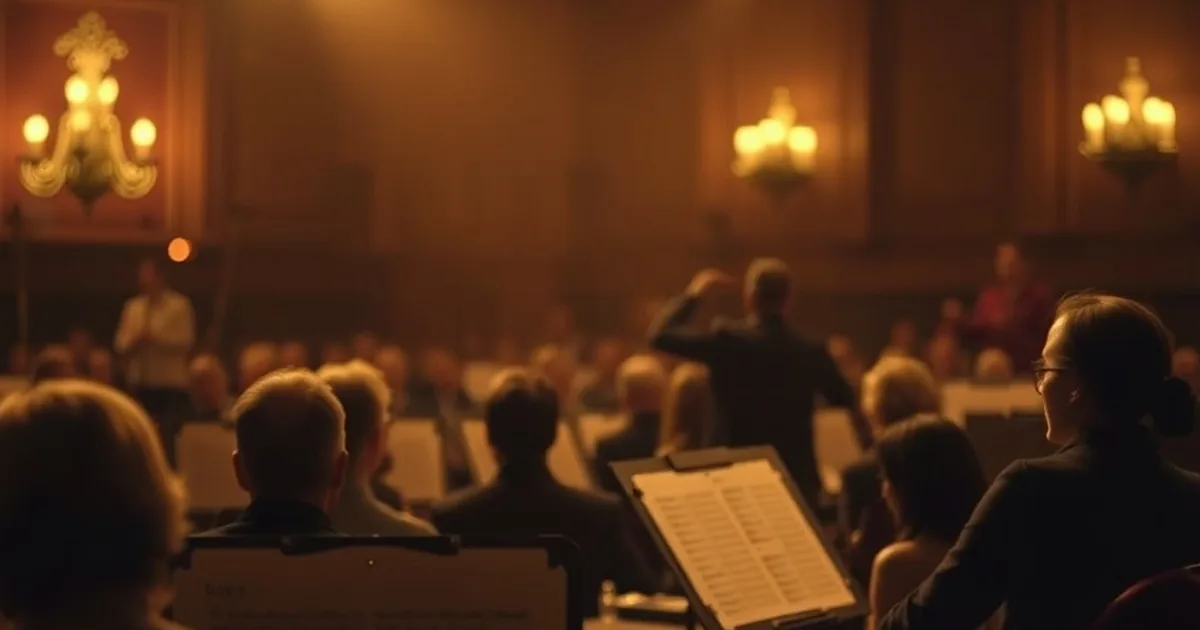
Gothenburg Symphony Orchestra concerts 2026: guide to the orchestra's autumn
His name may mean nothing to you, but the image sticks: a conductor in well-worn jeans, with wild hair, who could just as easily be heading to the skate park as up to the podium in front of Sweden's national orchestra. For eight years he was the face audiences met at Gothenburg Symphony Orchestra concerts. And before the baton took over, he competed in the Finnish selection for Eurovision Young Soloists, as a percussionist. Rouvali competed in the Finnish qualifying round for Eurovision Young Soloists 2004 as a percussionist.
Santtu-Matias Rouvali joked about it himself. He said he might look like a skater, which has sometimes meant orchestras didn't have particularly high expectations, but that they notice he knows his craft once they start playing together. That an orchestra in Gothenburg attracts that kind of name says something about what it actually is. This guide sorts out what's happening, who has shaped the sound and how to find your way when you want to book.
Gothenburg Symphony Orchestra concerts this autumn: next performance
The next opportunity to hear the orchestra right now is a pop-up concert at Frölunda Torg on 21 August 2026. It's a low-cost, audience-friendly variant of Gothenburg Symphony Orchestra concerts, far from the formal concert hall.
The orchestra's true home stage is the Concert Hall at Götaplatsen, but it also steps out into the city. On 21 August 2026, the musicians will appear at a shopping centre in western Gothenburg for the Pop-up concert with the Symphony Orchestra at Frölunda Torg. It's a smart way to lower the threshold: you don't need to know anything about symphonic music to stop, listen and feel whether this is something for you.
For those already familiar with Gothenburg Symphony Orchestra concerts, such outings are a welcome feature. The orchestra has a long history of playing outside the hall, and for the curious, a pop-up concert is the easiest way into their world before the autumn season gets properly underway inside the concert hall.
Sweden's national orchestra since 1997
The Gothenburg Symphony Orchestra was founded in 1905 and was designated Sweden's national orchestra in the 1990s. It is the country's oldest professional symphony orchestra and one of Europe's leading ensembles.
The orchestra was founded in 1905, with Heinrich Hammer as its first chief conductor. It stands out from the very beginning: it is considered Sweden's first full-time professional orchestra. The big leap came a few years later. Wilhelm Stenhammar was the orchestra's chief conductor 1907-1922 and gave it a distinct Nordic profile, inviting colleagues Carl Nielsen and Jean Sibelius. The fact that Sibelius himself stood at the podium in Gothenburg explains in part why the orchestra still has a special relationship with his music.
In the post-war period there were ups and downs, until an Estonian conductor turned things around. During Neeme Järvi's tenure as chief conductor, the longest of any chief conductor in the orchestra's history, its reputation on the world stage grew considerably, with sponsorship from Volvo and a recording contract with Deutsche Grammophon. He led the orchestra 1982-2004, and the international breakthrough is datable: the major international breakthrough for the Gothenburg Symphony Orchestra came in 1983 when the orchestra travelled to the USA and performed at Carnegie Hall, among other venues.
The status of national orchestra is no marketing title, but a decision made by parliament. The orchestra received the title of Sweden's national orchestra in 1997. Today it is an established institution in Swedish musical life, with a broad repertoire. Although the orchestra has a wide repertoire, it has a particular affinity for the Nordic late romantics, such as Jean Sibelius and Edvard Grieg.
Who was Santtu-Matias Rouvali?
Rouvali was chief conductor 2017-2025 and put Gothenburg back on the international map. He is a trained percussionist and divides his time with the Philharmonia Orchestra in London.
When he was announced, he was no unknown face in Gothenburg. The Gothenburg Symphony Orchestra got its fifteenth chief conductor in Santtu-Matias Rouvali. His background is thoroughly musical. Rouvali was born in Lahti into a family of musicians, and his parents played in the Lahti Symphony Orchestra. His path to the conductor's podium went via percussion. He learned percussion as a young person and continued his studies at the Sibelius Academy, where at the age of 22 he turned more towards conducting under teachers such as Jorma Panula, Leif Segerstam and Hannu Lintu.
The combination of youthful energy and craftsmanship led reviewers to draw comparisons. Rouvali has strong charisma, and a comparison with Gustavo Dudamel was close at hand. That is no coincidence, as Dudamel preceded him in Gothenburg. During Rouvali's years the orchestra made acclaimed tours and recordings, including a celebrated Sibelius cycle. His tenure lasted eight seasons. The Finnish conductor Santtu-Matias Rouvali was chief conductor of the Gothenburg Symphony Orchestra from the 2017-2018 season to the 2024-2025 season.
He did not disappear from the major stages when he left. Rouvali is chief conductor of the Gothenburg Symphony Orchestra and principal conductor of the Philharmonia Orchestra in London. That, then, is the kind of name Gothenburg audiences grew accustomed to at Gothenburg Symphony Orchestra concerts for nearly a decade. When you buy a ticket today, that is the level the orchestra sets for itself, regardless of who is at the podium on any given evening.
The Concert Hall at Götaplatsen
The orchestra plays around a hundred concerts a year at Gothenburg Concert Hall, a functionalist gem at Götaplatsen from 1935 with 109 musicians on stage.
The home stage is a sight in itself. The Gothenburg Symphony Orchestra was founded in 1905 and today consists of 109 musicians, and the orchestra is based at Gothenburg Concert Hall, a functionalist gem at Götaplatsen that has enchanted music lovers since 1935. The hall is built for its purpose. The Main Hall, the orchestra's principal stage, has walls and ceiling clad in warm plane wood and seats up to 1,247.
The programme is broader than many expect. The Gothenburg Symphony Orchestra plays around 100 concerts a year at the concert hall, with international star conductors and world-renowned soloists, and the programme encompasses classical works by composers such as Mozart and Beethoven as well as new music, film music and exciting genre crossovers. That means you don't need to be well versed in classical music to find something. One evening might be Beethoven, the next film music.
Behind the scenes there are more names worth knowing. Anna-Karin Larsson is CEO and artistic director, Gustavo Dudamel honorary conductor and Neeme Järvi conductor emeritus. The role of principal guest conductor is now shared. Barbara Hannigan has been principal guest conductor since the 2019 season, and since the 2025-2026 season Pekka Kuusisto also holds the title of principal guest conductor. And anyone wishing to follow a single soloist throughout an entire season has been given a clear pointer: Artist in Residence 2025-2026 is the international star violinist Ava Bahari from Gothenburg.
How to buy tickets
Tickets for regular concerts are sold through the orchestra's official channel, gso.se. The next opportunity right now is the pop-up concert at Frölunda Torg on 21 August 2026.
For the orchestra's own concerts at the concert hall, the safe route is the official ticket page, gso.se. There you will find the full autumn programme, seating maps and information about children's and youth activities. A tip is to keep an eye on the season opening in September, when the orchestra usually opens with a festive programme.
If you want to get started quickly without planning weeks ahead, the outdoor and pop-up variants are the easiest option. Concretely, the Pop-up concert with the Symphony Orchestra at Frölunda Torg takes place on 21 August 2026. It's a good way to try the format before booking a seat inside the hall. For a collected overview of what else is happening musically in the city, you can also browse our concert overview and the events calendar.
More music and culture in Gothenburg
Around the symphony orchestra's programme there is a wide cultural offering in Gothenburg in August, from city festival to theatre and dance, that fits the same weekends.
A concert evening is often better with something around it. The last weekend of August the city fills with Göteborgskalaset 2026, the city's big summer festival, starting on 27 August. If you're more in the mood for stage than symphony, Gothenburg Dance and Theatre Festival is at Stora Teatern from 21 August, the same day as the pop-up concert.
Among the artists associated with Gothenburg and the west coast is Yukimi, known as the voice of Little Dragon, a good example of how broad the city's musical life stretches beyond the classical scene. If you'd rather have theatre with a documentary edge, Nadim - min väg från flykting till hela Sveriges polis is at Göteborgs Stadsteater on 14 August. In other words: even if symphonic music isn't quite your thing, there are plenty of alternatives the same weekend.
Frequently asked questions about Gothenburg Symphony Orchestra concerts
When does the Gothenburg Symphony Orchestra next perform?
The next event we list is a pop-up concert with the Symphony Orchestra at Frölunda Torg on 21 August 2026. The orchestra also plays around a hundred concerts per year at Gothenburg Concert Hall, so the autumn season quickly fills up with more dates.
Where do I buy tickets?
Tickets for the orchestra's regular concerts are sold via the official site gso.se, where you can see the full programme and choose your seat. Pop-up and outdoor concerts often have simpler arrangements or free entry, so it's worth checking the individual concert's page.
Where does the orchestra perform?
The home stage is Gothenburg Concert Hall at Götaplatsen, inaugurated in 1935. The hall seats just over twelve hundred and is known for its acoustics. Alongside that, the orchestra also plays out in the city, for example at shopping centres and squares.
Who is the chief conductor?
Santtu-Matias Rouvali was chief conductor from the 2017-2018 season through to 2024-2025, a total of eight seasons. The roles of principal guest conductor are today shared by Barbara Hannigan and Pekka Kuusisto, while Neeme Järvi is conductor emeritus and Gustavo Dudamel honorary conductor.
Do I need to know about classical music to attend?
No. The programme ranges from Mozart and Beethoven to film music and genre crossovers, and a pop-up concert is a low-threshold way to try it out. If you choose an evening at the concert hall, it's worth reading the short programme note in advance to get more out of the experience.
Sources
- Gothenburg Symphony Orchestra, official website: gso.se (orchestra history, conductors, concert hall)
- Wikipedia: Gothenburg Symphony Orchestra and Santtu-Matias Rouvali (founding, chief conductors, national orchestra)
- HarrisonParrott, artist page for Gothenburg Symphony (chief conductors and tours)
- nupagang: Pop-up concert with the Symphony Orchestra, Frölunda Torg, 21 August 2026
- nupagang: Göteborgskalaset 2026 and Gothenburg Dance and Theatre Festival
- nupagang: concert overview and events calendar